Skincare Ingredient Checker: What the Label Can—and Cannot—Settle
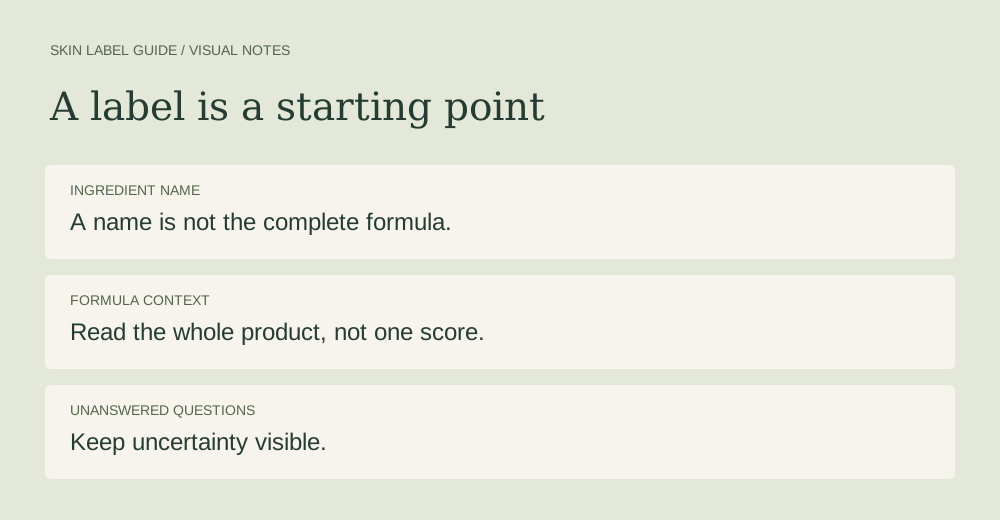
A skincare ingredient checker can identify ingredients and explain their possible functions. Use it to investigate a label, then check the actual product experience and the evidence behind its claims. It cannot recover an undisclosed formula from ingredient names.
Start with the first five, but do not stop there
A quick screening method starts with the first five ingredients. A more cautious approach resists using that shortlist to accept or reject a product. The useful tension is between speed and certainty: the shortlist helps you get oriented, but it does not settle the purchase.
Bubble Level Up Balancing Moisturizer supplies a concrete counterexample. In the ingredient list discussed, hemp seed oil appeared among the first five ingredients. That prompted an expectation of a richer moisturizer, yet the reported experience was an extremely lightweight gel. This is a mismatch between a prediction and a reported texture, not two people proving opposite things about the same product.
Read the rest of the list before deciding. Under US labeling rules, ingredients at one percent or less may appear in any order after ingredients above one percent; color additives have a separate exception. A low position does not supply an exact concentration. FDA labeling guide
A familiar ingredient can be doing an unfamiliar job
A function lookup can tempt you to label the entire product: acid means exfoliant, for example. The more careful interpretation asks what that ingredient is doing in this particular formula. Salicylic acid has a preservative use as well as other cosmetic uses, so recognizing its name does not establish the product’s purpose. EU regulation
A less obvious detail concerns how raw materials become label entries. A supplied blend may be broken into its component ingredient names on the finished label. Optiphen, for example, is identified as phenoxyethanol and caprylyl glycol in its supplier documentation. Seeing those separate entries does not reveal whether they arrived separately or as that blend. Nor does it disclose the amount of either one. Ashland documentation
Keep the name, possible function, and product claim separate. The checker can explain the first two without proving the third.
Record the texture failure against the product
One reported experience makes the distinction unusually clear: dimethicone felt too much like a primer in two products, while other products containing dimethicone were favorites. The same person disliked and liked formulas containing the same named ingredient. That is useful evidence against turning a texture complaint into a permanent ingredient ban.
There is also a raw-material detail the label leaves out. Dimethicone comes in different viscosity grades; the ingredient name alone does not identify the grade. Supplier information describes dimethicone fluids with different physical properties. Even identifying the grade would not reconstruct the complete formulation. Dow product information
Write down what actually failed: primer-like finish, pilling, or an unpleasant application. Leave the cause open unless it has been established. A checker’s ingredient description cannot substitute for that product-specific record.
Separate an avoidance preference from an allergy
The screening approaches also differ over fragrance. One makes undisclosed fragrance a personal reason to reject a product. Another avoids blanket ingredient exclusions when there is no individual allergy or other personal reason. These are different decision rules, not conflicting measurements of one formula.
Neither position supplies a breakout timeline or proves that a particular fragrance caused a particular reaction. Keep a preference, a suspected reaction, and a confirmed allergy in separate notes. A negative experience deserves recording without silently upgrading the suspected cause into a diagnosis.
US labels may declare fragrance components collectively as fragrance. Looking up that word therefore cannot identify every component of the blend. If a diagnosed allergy remains unresolved by the label, ask the manufacturer or your clinician. FDA fragrance labeling · FDA allergen guidance
Check what the supporting study actually tested
A detail easy to miss is the difference between evidence about a supplied raw material, evidence from a laboratory model, and evidence about the finished product being sold. An ingredient explanation can sound persuasive while leaving that distinction unanswered. Before accepting the advertised result, identify which of those things was tested.
This is where the checker should hand the question back to the product evidence. If a supplier study supports an ingredient but no finished-product study is supplied, preserve the ingredient finding and leave the finished-product claim unverified. Absence of a supplied study does not prove that the product fails.
Finish with three separate notes: what the label establishes, what your actual product experience establishes, and what still needs evidence. That record is more useful than a confident verdict built from ingredient names alone.